





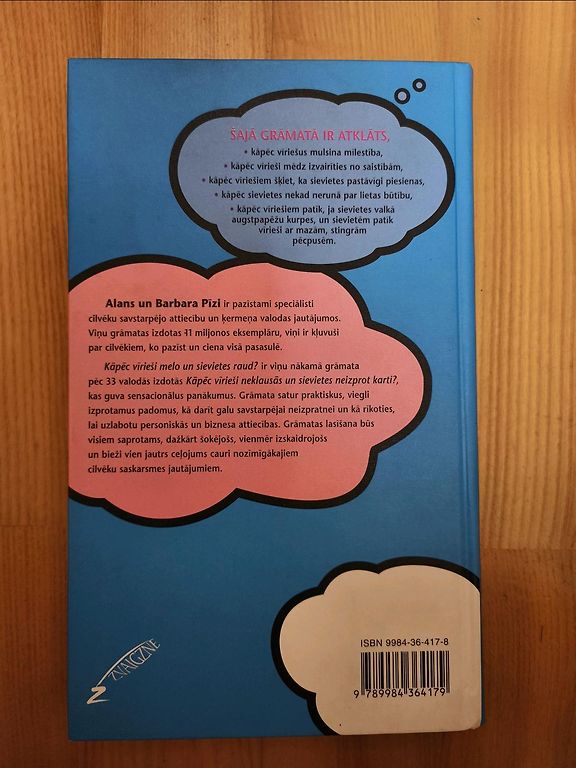
Why do men lie and women cry
| Brand | Zvaigzne ABC |
| Condition | Used, in perfect condition |
| Language | Latvian |
| Added | Today, 17:2965 |
Allan + Barbara Pease
Why Men Lie and Women Cry
Shocking, entertaining, and sometimes funny...
The authors highlight a significant difference in the development of men and women. Specifically, women evolved in groups with other women and children, staying close together as they lived in caves. The ability to form close relationships was crucial for each woman's survival. Meanwhile, men evolved by sitting silently on a hill, observing moving targets. When women engaged in a joint activity, they constantly chatted,
which was a sign of bonding, while men hunted or fished in silence to avoid startling the prey. This communication model from human evolution actually aligns with modern world dynamics – today's women go to gather food (shopping), and we still constantly chat, whereas our men often go fishing or hunting, remaining more silent than talkative. The authors of the book point out that when studying the brains of women and men during a conversation, it is revealed that women's brains adapt to speech and language functions. It turns out that women's brains can effortlessly produce 6,000 to 8,000 words a day, while men's brains have a maximum productivity of 2,000 to 4,000 words a day. Such a difference makes you wonder, doesn't it? Because it is possible that a working man may have exhausted his word quota by the afternoon, and when he comes home to a woman who still needs to express her words, it can create problems.